__if_exists keyword in microsoft c++
__if_exists allows you to check a class have member or not. __if_exists用于检查类中是否存在某成员
__if_exists(class::member)
标签:
windows
日期: 2016-04-22 17:30:06, 10 years and 123 days ago
__if_exists allows you to check a class have member or not. __if_exists用于检查类中是否存在某成员
__if_exists(class::member)
通过阅读官方手册进行学习是自我提高的捷径。
MSDN的一般结构为:
super topic
 \
  + topic - Overview -+- About
     |                |
     |                +- Using
     |                |
     |                +- Reference
     +--- relation topics
每个主题都有一个Overview,以摘要形式简单介绍主题的相关内容。
每个主题都包含: 关于about 用法using 参考reference 三部分。
以GDI文档为例:https://msdn.microsoft.com/en-us/library/vs/alm/dd145071.aspx.aspx)
... > Archive > Graphics > Windows GDI
-------------------------------------------+-----------------------------------
                                           |Multiple Display Monitors is ....
...                                        |
v Multiple Display Monitors                |
 v About Multiple Display Monitors         |
    The Virtual Screen                     |
    ...                                    |
 > Using Multiple Display Monitors         |
 > Multiple Display Monitors Reference     |
                                           |
顶部为其父主题,左侧为此主题的章节部分。右侧为此主题的概述。
lib staticlibrary.lib /List
lib staticlibrary /EXTRACT:membername
objdump -S membername.obj > membername.asm
Swift类定义前加入@objc关键字,并使类继承自NSObject
@objc class S : NSObject{
    func m() {
        print(__FUNCTION__)
    }
}
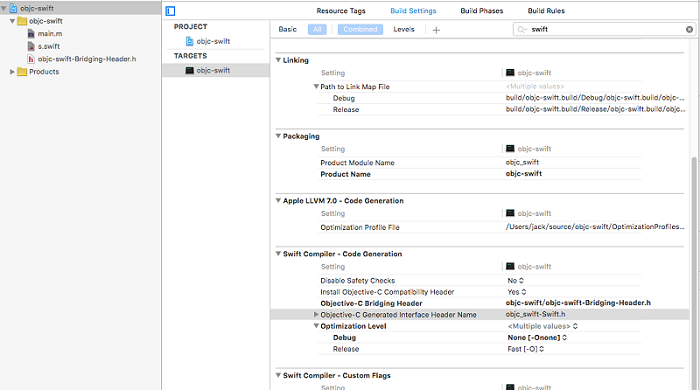
头文件具体的名字可在 设置选项:
{project} - {targets} - {build settings} - {swift compiler - code generation} - {Objective-C Generated Interface Header Name}
 #import "objc_swift-Swift.h"
int main(int argc, const char * argv[]) {
   @autoreleasepool {
        S* s = [[S alloc]init];
        [s m];
    }
    return 0;
 }
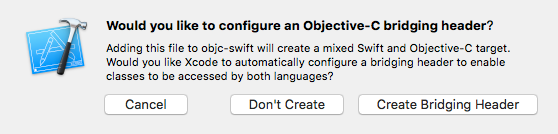
选择Create Bridging Header
{project} - {targets} - {build settings} - {swift compiler - code generation} - {Objective-C Bridging Header}
//
//  Use this file to import your target's public headers that you would like to expose to Swift.
//

 #import "O.h"
.h 文件
@interface O : NSObject
-(void)m;
@end
.m 文件
@implementation O
-(void)m {
    NSLog(@"%s", __FUNCTION__);
}
@end
swift 文件
@objc class S : NSObject{
    let o:O = O()
    func m() {
        o.m()
        print(__FUNCTION__)
    }
}